From Kilograms to Circularity

Image generated using AI
Units Alone Are Not Enough
Throughout history, measurement systems have shaped how societies trade, collaborate, and innovate. The introduction of standardized units like the kilogram and the centimeter allowed humans to quantify the world with precision. But these units alone were not sufficient. A kilogram was only useful once a scale existed to measure it. A centimeter only became actionable when paired with a ruler or meterstick. Units required tools of interpretation to become meaningful.
Today, in the context of the circular economy, we find ourselves at a similar moment. We have a unit: the Product Circularity Data Sheet (PCDS)—a standardized digital format to describe the circular characteristics of a product. And we now have a tool: the Circularity Tracker, a system that interprets PCDS data to make it usable and comparable.
=> https://circulartracker.eu/
In this article, we explore the historical development of measurement systems and their tools, and draw a parallel to today’s emerging circular data infrastructure. We argue that while the PCDS is necessary as a unit of circularity, it is not sufficient. To unlock its full value, we need a system like the Circularity Tracker to act as the “scale” of circularity measurement—allowing us to interpret, compare, and act on circularity data at scale.
The PCDS, developed in Luxembourg, is a structured data format that describes a product’s circular profile. It includes indicators such as recycled content, next-use potential, separability, and material recovery. The Circularity Tracker, developed by +ImpaKT, is a digital solution that evaluates and compares these characteristics to support product development, procurement, and regulatory compliance.
A World Without Scales or Rulers: Measurement Without Application
Before the adoption of standardized measurement systems, Europe functioned under a confusing and fragmented landscape of local units. Each region had its definitions for length and weight, which made trade difficult, scientific progress unreliable, and taxation inconsistent. The introduction of the meter and the kilogram during the French Revolution represented a radical shift toward universality and scientific reasoning. However, these units only became transformative when paired with tools that allowed people to apply them in practice—namely, the scale and the meterstick.
The scale allowed the kilogram to be used in everyday commerce, ensuring that goods could be weighed fairly and transactions could be trusted across regions. It made taxation more transparent and enabled logistical systems to function with precision. The meterstick brought the concept of the meter into construction, land management, and industrial manufacturing. It enabled the production of interchangeable parts and the consistent measurement of materials, which were critical to the development of mass production and quality control.
Together, these tools turned abstract units into operational systems. They enabled replicable scientific experiments, engineering standards, and national governance mechanisms based on measurable data rather than arbitrary rules. The scale and the meterstick allowed measurements to become the foundation of laws, trade agreements, and technological progress. Their systemic impact was so profound that they helped usher in the modern industrial economy by making consistency, comparability, and trust possible across institutions, borders, and disciplines.
The PCDS: A Standard Unit for Circularity
In the modern push for sustainability, the Product Circularity Data Sheet (PCDS) offers a clear parallel to early measurement units. It defines how a product’s circular features are described using a harmonized vocabulary and a machine-readable data structure.
Among the core characteristics covered by the PCDS are recycled content, next-use potential, material recovery potential, and separability—describing the ease with which components or materials can be disassembled without degrading their function. The PCDS also includes transparency of data source, specifying where and how the underlying information was verified.
By enabling these circularity features to be expressed consistently across sectors and supply chains, the PCDS provides a critical foundation for circularity metrics. It supports regulatory alignment with initiatives such as the EU Taxonomy, Digital Product Passport, and ISO 59040. However, just as a centimeter doesn’t measure anything until it is applied with a ruler, the PCDS remains a descriptive format. It tells us what to measure—but not how circular a product is in relation to others.
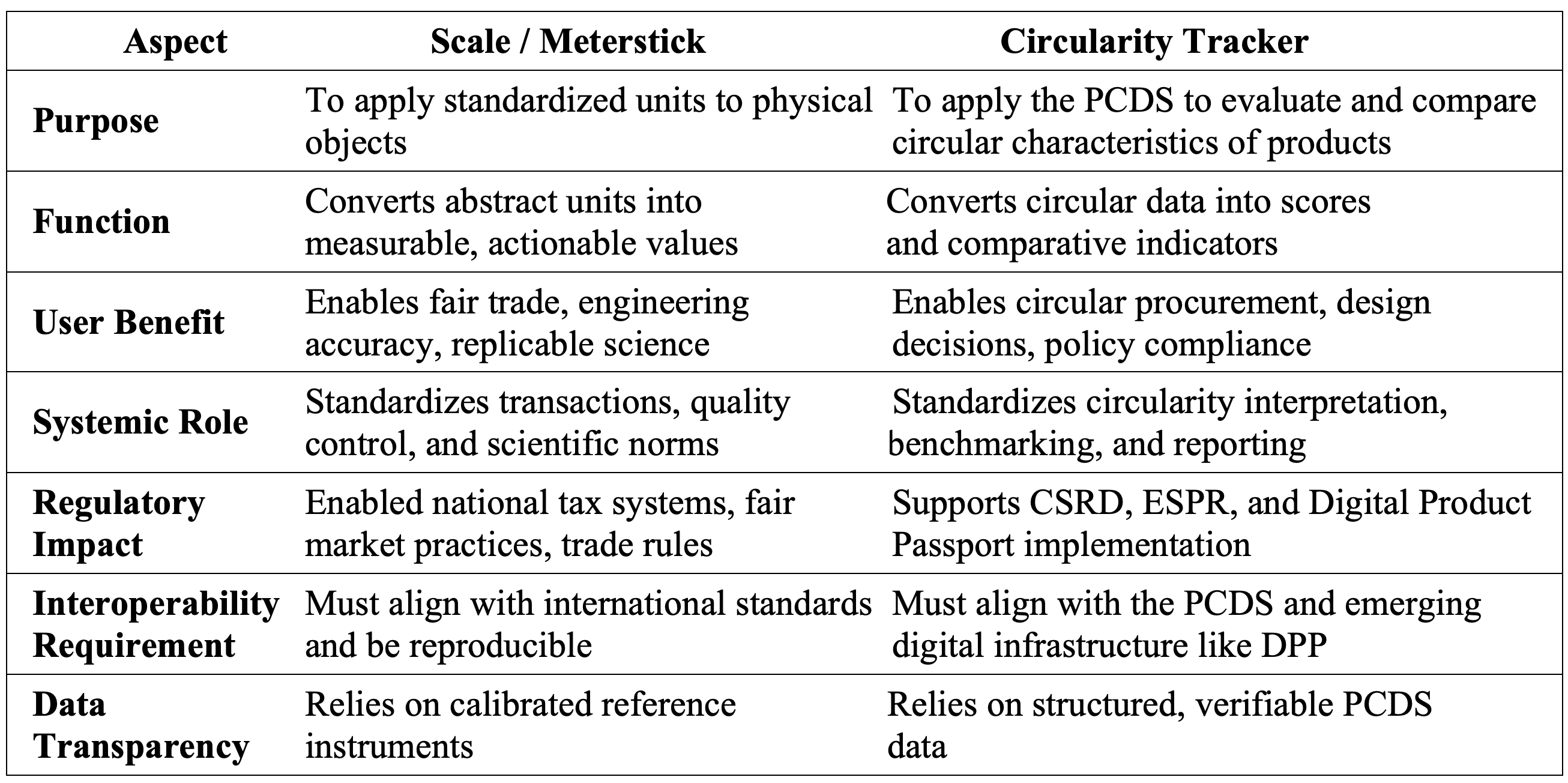
To visualize this: the PCDS is the ruler, but the Circularity Tracker is the hand that places it along the object, enabling measurement and comparison.
The Role of the Circularity Tracker: A System for Evaluation and Comparison
The Circularity Tracker, developed by +ImpaKT, is a digital system that evaluates and compares circularity data drawn from PCDS-compliant formats. After extensive prototyping and testing, the system is now being launched as a practical tool for designers, product managers, procurement officers, and regulators who need to make decisions based on reliable circularity information.
It works by interpreting the PCDS data and applying a scoring logic that allows for benchmarking across products, tracking improvement over time, and aligning performance with sustainability goals or procurement criteria. In doing so, the Circularity Tracker acts as the equivalent of a calibrated scale—transforming the unit into something actionable and comparable.
This system doesn’t replace the PCDS; it completes it. One provides the language. The other provides the logic.
=> https://circulartracker.eu/
Example: Comparing Two Laptops
Imagine two laptops, both marketed as sustainable. Laptop A is made from 40% recycled plastic, features a modular design, and is easy to repair. Laptop B uses only 10% recycled content, is glued shut, and offers limited repairability. Both manufacturers publish their circularity characteristics using the PCDS.
Using the Circularity Tracker, Laptop A scores significantly higher on material recovery, next-use potential, and separability. Laptop B, while compliant with some basic criteria, falls short in key design-for-circularity indicators. A purchasing team or regulatory body can now compare these two products quantitatively, making informed and transparent decisions possible.
Why We Need the Full System: Unit + Instrument
The PCDS and the Circularity Tracker together form a measurement system. One without the other leaves a gap. Circularity data without interpretation is like knowing the length of something but having no way to compare it. Conversely, attempting to evaluate circularity without a standardized unit yields inconsistent and incomparable results—and ultimately, greenwashing.
This system-level view reflects the evolution of sustainability governance. As regulators demand more traceable and auditable ESG data, and as markets begin to price in circularity performance, the need for tools that can convert data into insights becomes urgent.
Just as industrial economies needed weights and measures—and the instruments to use them—the circular economy needs both circularity units and systems to apply them.
Known Limitations and Considerations
Evaluating circularity is not without complexity. Trade-offs between longevity and material purity, regional variations in end-of-life infrastructure, and data gaps in global supply chains all present real challenges. The Circularity Tracker is not a one-size-fits-all solution but provides a consistent baseline for evaluation.
As the system evolves, further stakeholder input and sector-specific adaptations will be essential. Transparency about assumptions and limitations will remain critical for credibility and uptake.
Conclusion: From Concept to Comparison
History shows us that units of measurement become transformative only when paired with tools of interpretation. In the past, a kilogram became useful when we invented the scale. A centimeter changed global construction and engineering when paired with a ruler or meterstick.
Today, the Product Circularity Data Sheet gives us the unit for circularity. But to make it operational—to evaluate, compare, and regulate—we need a system like the Circularity Tracker. With this combination, we can shift from aspiration to application, and from promises to performance.
By building tools that mirror the structure of successful measurement systems of the past, we give the circular economy the infrastructure it needs to scale. Circularity becomes not just a value—it becomes a measurable and comparable dimension of economic activity.
=> https://circulartracker.eu/
Key References
Alder, K. (2002). The Measure of All Things: The Seven-Year Odyssey and Hidden Error That Transformed the World. Free Press.
Heilbron, J. L. (1990). Weighing Imponderables and Other Quantitative Science around 1800. University of California Press.
Quinn, T. (2012). From Artefacts to Atoms: The BIPM and the Search for Ultimate Measurement Standards. Oxford University Press.
Stock, M., Barat, P., de Mirandés, E., & Firlus, M. (2019). The revision of the SI—the result of three decades of progress in metrology. Metrologia, 56(2), 022001. https://doi.org/10.1088/1681-7575/ab0013
Other news

Luxembourg Architecture Award: And the winner is…
Read more

Football, great fun and a fantastic team spirit!
Read more

New Elmen School Complex
Read more
