Why ‘Do more with less’ Is NOT a circular design principle
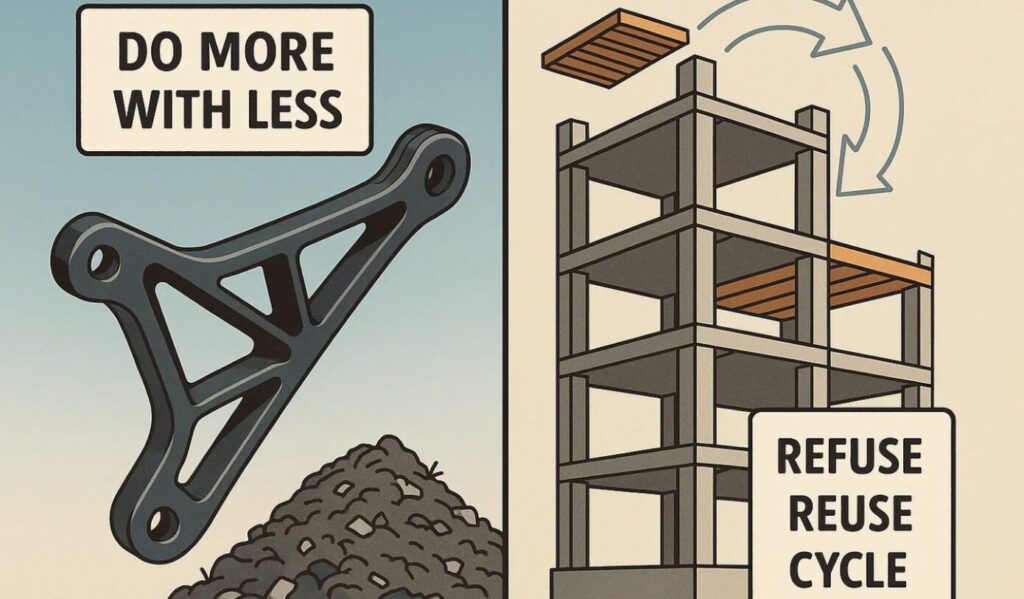
Image generated using AI
Not everything is truly circular!
In the growing discourse on sustainable design and circular economy, one mantra is often cited as inherently circular: “Do more with less.” While appealing in its simplicity and apparent efficiency, this principle has been misapplied as a pillar of circular design. In reality, “do more with less” is a linear design principle—and has been for decades.
The problem lies in its scope. “Do more with less” typically focuses on optimizing the production phase—reducing inputs, simplifying materials, and minimizing immediate costs or weight. But circular design demands a holistic, lifecycle-oriented approach: one that integrates production, use, and end-of-use considerations. Ignoring these later phases leads to trade-offs that can undermine sustainability.
Take for example the substitution of recyclable steel parts with lightweight glass fiber-reinforced high-temperature plastics. Yes, the new design uses less material and reduces weight, aligning with “do more with less.” But these plastics are not recyclable, locking the product into a linear end-of-life pathway and compromising long-term circularity.
Or consider architecture: designing a building to be expandable in the future may require a stronger initial structure, thus more material upfront. This seems inefficient at first glance. But by allowing for adaptation and reuse over time, the design supports circularity—offering longevity, flexibility, and reduced need for demolition and new construction.
Another case: disassemblable products. These may be heavier or more complex than minimally designed counterparts, but their ability to be repaired, upgraded, or recycled places them squarely in the realm of circular thinking. Here, adding complexity serves the cycle.
The key message: not everything efficient is circular. We must resist conflating minimal design with sustainable design. Efficiency at one stage of a product’s life does not ensure sustainability across its full lifecycle.
True circular design starts with a question often neglected in linear frameworks: Do we need this at all? This is the core of the refuse principle—the most powerful and overlooked “R” in the circular economy. The best material is the one you don’t use. Efficiency without necessity is still waste.
For circularity to be meaningful, we must commit to clearer, more precise communication. Designers, engineers, and policymakers need to evaluate design principles against the entire lifecycle. Let’s stop labeling every efficiency-driven design as circular and instead focus on strategies that genuinely close the loop.
Other news
Luxembourg Architecture Award: And the winner is…
Read more

Football, great fun and a fantastic team spirit!
Read more
New Elmen School Complex
Read more